Showing posts with label the Enlightenment. Show all posts

Friday, November 18, 2011

The Schism in Modern Political Thought

“I know your deeds, that you are neither cold nor hot. I wish you were either one or the other! So, because you are lukewarm—neither hot nor cold—I am about to spit you out of my mouth.” It’s better to be consistent - to be hot or cold. Even a man who sells his sword to the wrong cause, but fights like the Devil in defense of it, wins honor and respect from his enemies. In the same way, if a man believes something false, but believes it with all his heart, he earns a kind of honor by his sheer dedication. He weighed the sides of the controversy and chose one to throw his whole weight behind. But a man who's weak, inconsistent or illogical is not only wrong; he’s contemptible.

Perhaps this is why the philosophies of two men continue to inspire so much respect. Thomas Jefferson and Alexander Hamilton could not have been farther apart on the political spectrum of 18th century America. Where Jefferson trusted “the people” to order their affairs better than someone in Washington could, Hamilton excoriated them as slaves to the “impulse of passion.” Jefferson wanted low taxes and the self-reliance of local governments; Hamilton wanted high taxes and a policy of easy credit for industries, roads, canals and bridges. Distribution and decentralization of government, the Jeffersonian ideal, stood in stark contrast to Hamilton’s desire for a “common, directing power.” The differences extended into foreign policy as well. The gentleman from Virginia wanted the policy of limited government he advocated on American soil to be equally as limited abroad: “Peace, commerce, and honest friendship with all nations, entangling alliances with none.” The New York lawyer had his heart set not only on establishing a European-style government, but an army and navy imperial enough to win battles, glory and overseas possessions. Despite all these differences, these two men had one thing in common: the beliefs of each formed a logical, reasoned whole.

Regardless of which man history vindicated, both have an unimpeachable record of intellectual honesty. Both were consistent. They understood that beliefs filter through one’s whole worldview to form an integral whole; beliefs can’t be mixed and matched according to preference. They can't be pawned to win votes or do what’s politically expedient without shaking the whole foundation on which they rest. Hamilton knew and admitted that an aggressive foreign policy required a complex, bureaucratic state at home. Jefferson knew that power corrupted. This led him to the conclusion that small government at home was meaningless if a powerful military establishment tempted the young republic into wars and empire-building. As his friend James Madison said, "War is the parent of armies; from these proceed debts and taxes; and armies, and debts, and taxes are the known instruments for bringing the many under the domination of the few." Republicans today have rebuked their heritage as the party of humble foreign policy and instead embraced a massive military-industrial complex – as if this can be maintained with the low taxes and small government they trumpet. Democrats are no better. How can a welfare state of crony capitalism and exploding government hope to preserve the liberties the party professes such attachment to? Today's administration and its rivals insult our intelligence. Hamilton –whatever else one might say of him- would have known better.

Friday, November 11, 2011

In Praise of Myth

Before God was declared dead in 1882, the European elite had lost their willingness to believe. Nietzsche’s famous statement simply reflected the grave error of thinking that the intelligentsia’s lack of faith had nullified God’s faithfulness. Years before, European academia as a whole, stretched and stressed between rationalism and pantheism for decades, had made the fatal decision to play it safe and discard faith for reason. These Deists, blind to anything but what they could stare at past their own noses, promptly found that the next logical thing to do was to throw out the object of their faith, too.

Yet despite the relentless march of over a century-and-a-half of “progress,” the rocks still haven’t had to cry out (it must be frustrating to be a secular visionary). It seems that faith in something is as fundamentally needed in the human condition - even in its fallen-ness- as breathing. Think about it. It doesn't matter what archaeologists' spades do or don't uncover deep in the English loam. King Arthur held court in Camelot, surrounded by a troop of gallant knights. In the same way, the story of Robin Hood emerging from the shadowy eves of Sherwood Forest to secure justice for the oppressed is every bit as real in our mind's eyes as if he had existed just as the tales say he did. 

Decades of stressing objectivity, empiricism and rationalism in our schools have failed to erase these pictures, these “forms” that lie somewhere in the back of our minds in a place reason can’t reach. In the process of trying to snuff them out and preach only what we can know with absolute certainty, we've reduced history to a jumble of numbers and equations and proofs. Endless pages of quantitative statistics are needed to establish causality – and even then scientists accept that, at best, we can only know “probabilistic” truth. We've bumped up against the same wall through reason for which we through faith out the window.

And here we are, unable to teach Arthur or Robin Hood in history courses; unable to incorporate our highest aspirations and fears – in short, anything resembling a purposeful story – into scholarship. But why? Are these impressions false? Do they pervert our sense of history simply because they can’t be corroborated by a rock some farmer's plow caught upon by chance? Quite obviously, in the search for absolute meaning, it’s a zero-sum game: science has come up just as short as “myth.” I’m not saying legends should be taught as fact, but I am saying that they would not have been believed in the first place unless they contained a grain of truth. More importantly, in their essence they convey more truth than ten thousand pages of quantitative analysis. Arthur embodied for the Welsh the same kind of hope in a temporal redemption that they had in a spiritual one. Robin Hood will always be a lesson of compassion and justice conquering in the face of unjust rulers. In the words of Winston Churchill, "It is all true, or it ought to be." Which is safer? To accept things that we can't know beyond the shadow of a doubt and risk being wrong once in a while, or to acknowledge that we can't know anything?

Thursday, October 20, 2011

The Language of Creation

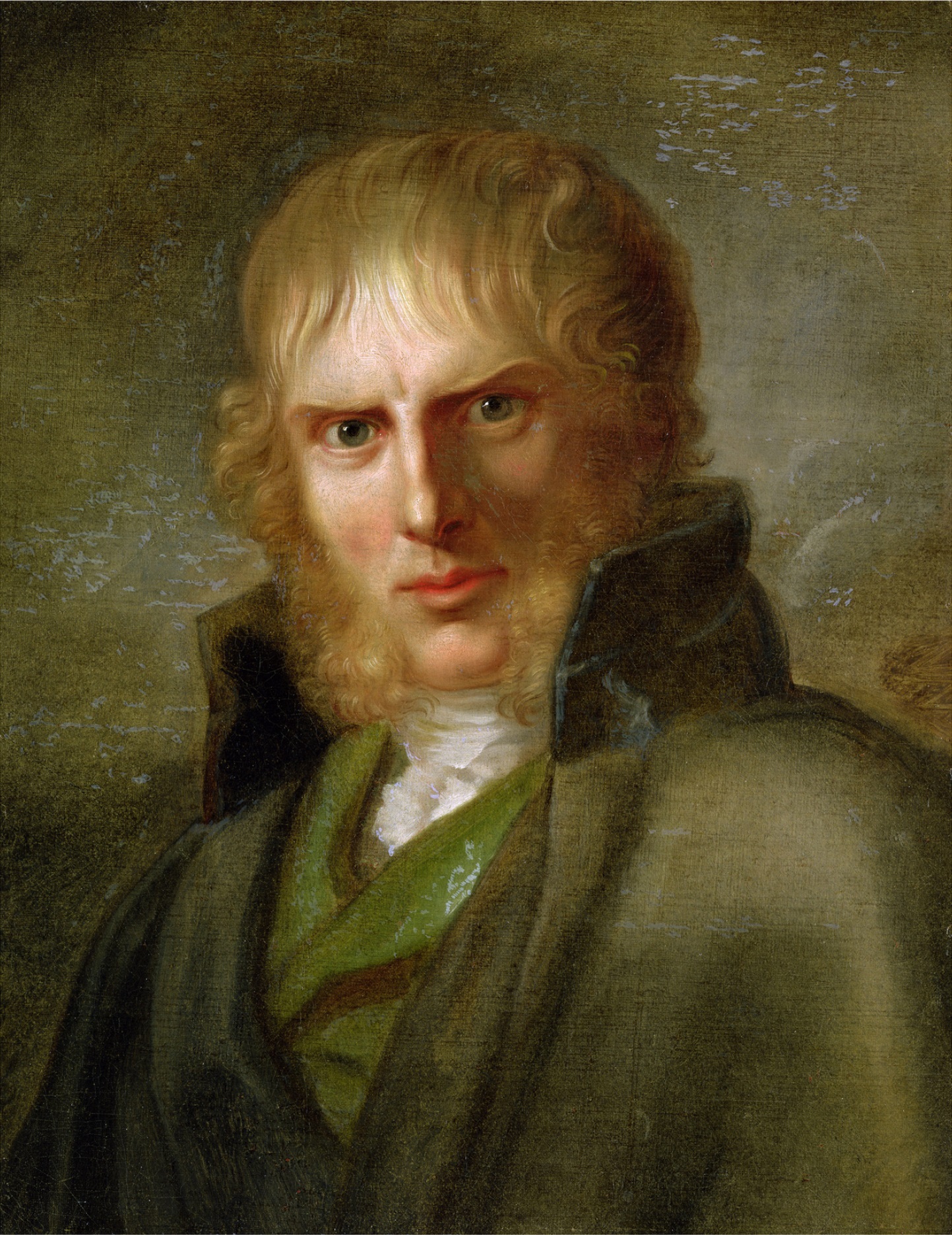
"Caspar David Friedrich in his Studio,"
Georg Friedrich Kersting, 1819
Christmas Day, 1807. The Count of Thun and his family fought blustery winds on their way to their private chapel at Tetschen castle, Bohemia. This year's religious pageantry was made all the more spectacular by a new addition to the sanctuary. There, in place of the old, ponderous altar-piece stood a newly-finished masterwork. A glinting frame enrounded a painting of Calvary reimagined in an Alpine setting, craggy and crowned by firs. The cross itself stood silhouetted by the brilliant pink hues of a setting sun. This was The Cross on the Mountains, the first major work in what was to be the long and brilliant career of German painter Caspar David Friedrich.

This painting was not just an expression of faith, it was a way for the Thun family to show a cosmopolitan streak. Friedrich’s work was part of a fashionable new movement that was attempting to wash the Enlightenment out of Western Europe. The previous century's overreaching search for rational truth had left the earth a barren wasteland through its insatiable desire to force all knowledge inside of men’s heads. Mysteries and miracles that didn’t conform to formulas had been rejected. For the first time in centuries, Christianity had been publicly attacked. The artists in this new school styled themselves “romantics.” By depicting the inexplicable, the beautiful, and most of all, nature in its glory, they sought to free men from bondage to their minds. Others, chief among them Caspar David Friedrich, painted to remind men that it was not just truth that could be found throughout all of creation, but the truth of the Christian God.

The Cross on the Mountains drew its most vehement criticism, not from Deistic intellectuals, but from a most unlikely source: a fellow Christian. That Christian was the aptly named Basilius von Ramdohr. Unlike Friedrich, von Ramdohr was born and bred among the upper classes of German society. He had acquired a reputation as a conservative lawyer and defender of traditional German values, which led to a career as a cultural critic. With a hint of contempt, no doubt, von Ramdohr went to see Friedrich’s much talked about "romantic" piece when it was on special display. He was deeply unsettled by the painting, so much so, in fact, that he wrote a painstakingly long refutation of the ideas he saw represented in it. He objected that the pine trees had been illustrated to the point of painting each needle. The way the light was rendered was against “all the rules of optics.” And what of landscape paintings themselves? Surely nature itself can contain no explicit meaning and is improper in a church. The rock was rendered poorly, a “most strident contrast to the bright sky, without any transition or harmony.” Perhaps worst of all, in von Ramdohr's opinion, the cross was not located in the center of the painting, and Jesus was not facing the viewer – and surely this would convey the wrong message to worshipers..

With his fledgling reputation at stake, Friedrich was forced to respond. His answer? “Jesus Christ, nailed to the tree, is turned here towards the sinking sun, the image of the eternal, life-giving father. With Jesus’ teachings, an old world dies – that time when God the Father moved directly on the earth. This sun sank and the earth was not able to grasp the departing light any longer. There shines forth in the gold of the evening light the purest, noble metal of the Savior’s figure on the cross, which thus reflects the earth in a softened glow. The cross stands erect on a rock, unshakeably firm like our faith in Jesus Christ. The firs stand around the cross, evergreen, enduring through all ages, like the hopes of man in Him, the crucified.”

Unfortunately, it is very easy for us Christians to make the same mistake von Ramdohr did. In our very desire to keep the Gospel pure, it is tempting to keep our artists in the shadows. We are prone to confusing convention with the Gospel; to thinking that a change in style means a change in substance. Can God only speak through us when we make sure that two pieces of wood are at the exact center of our painting like von Ramdohr wanted? The Bible tells us that God can speak through donkeys, rocks, burning bushes and David’s harp-playing. We forget that though symbols may change, Christ himself can still remain at the center of the work. The greatest stories of salvation are usually told, not through hackneyed altar-calls, but through metaphors. Jesus’ parables are prime examples of this. And what is nature but a majestic metaphor? By depicting Creation in a way that's good and beautiful (Philippians 4:8), we can challenge peoples' deepest beliefs. A God who's evident through the physical world challenges today's naturalists in a way they can't respond to. On the other hand, to deny nature’s revelation of God like von Ramdohr did is to deny what God called “good.” Like the Apostle Paul before his conversion, this man was an intellectual who thought he was advancing the kingdom of God by purging it of false revelation. It turned out that what they were both calling false was God's voice. What place do landscape paintings have in church? Friedrich showed in his response what the psalmist declared long before in chapter 19: "The heavens declare the glory of the Lord; the skies proclaim the work of his hands. Day after day they pour forth speech; night after night they reveal knowledge."

Thursday, September 8, 2011

Rousseau, Human Nature and Our Foreign Policy Problem

Put aside for a moment the constitutional arguments (and they are many) against being involved in the internal squabblings of governments overseas. Put aside the pragmatic arguments of finance and sustainability that see these wars for the vacuous black hole that they are. Even put aside the Founding Fathers' warnings against "foreign entanglements." Let's examine the philosophical moorings required to think we can"make the world safe for democracy."

As Christians, it is our duty to not only recognize, but actively live like we believe that sin is something each of us has the choice -the free-will- to indulge in or resist. Furthermore, God tells us in his word that man is fallen, that he delights in sin, just as St. Augustine delighted in stealing an apple, not to eat, but for the pure pleasure of sinning.  How does this reverberate into how we should see man's place in civil society? He is a law-breaker by choice. 

Not everyone agrees with what the Bible says, however. In fact, for a couple hundred years now it's been in vogue to take a position that owes more to Jean Jacques Rousseau: that man is born free and decent, and it's society's institutions that corrupt him. Break the back of these institutions and a violent man suddenly finds himself cherubized. Freud agreed. Man is a complex animal without a soul who responds to impulses in his environment. Pavlov believed that his famous discovery of reinforcement and the salivating dog was equally true of human beings: man is mechanical and needs stimuli to provoke the "right" responses. As these theories became mainstream, education shifted from its classical focus on searching for truth and instead began treating children like Pavlov's dog. It became about conditioning children to make the right responses to stimuli in the world.

Once this generation of children became adults, they could be found at the helm of this nation and most others in the Western world. They had a firm belief in the innate goodness of man - if only the harmful stimuli can be removed. Man is perfectible if he can just be given the right environment. Crime was no longer the rebellion of the soul, it was the automatic response to poverty and inner-city decay. Housing projects and the welfare state resulted. But there was something else, too. If this picture of human nature was true, then it was now within the grasp of the government of the United States of America not only to perfect its own citizens, but to perfect the citizens of the world - in effect to create a new world order of peace and prosperity for all. To free them to that natural state that Rousseau had talked about. Remove the evil effects of institutions and governments and you will cure the men under them. Or in more modern terms: "If we only remove the dictators, they will be good people." The French tried it in their Revolution of 1789. We did it in Cuba, in Europe (twice) and all across the third world ever since, and we've seen how it's played out. Iran was one of our first projects in the 1950s. Now it's Iraq and Afghanistan, which, despite all dreams of flag-waving Iraqi children, are not Jeffersonian democracies or anything remotely like. Egypt has been delivered, not to democracy, but to the Muslim Brotherhood. Now there are reports that Libya may be falling under the sway of Al Qaeda.

The problem of our foreign policy is primarily a problem with our view of human nature. Try as we might to export freedom and American ideals, our plans will continue to backfire until we understand that we cannot make men and women desire freedom by getting rid of the evil around them. Correcting our foreign policy starts with understanding that sin is a choice; that any inherent desire for freedom and democracy in the human race is outweighed by an inherent desire to sin. People around the world need to be reached by the Great Commission, not by Operation Odyssey Dawn.

Sunday, July 24, 2011

Thomas Jefferson and Leading By Example

A perilously high national debt, burdensome taxes, corruption, political favors, extreme partisanship, a powerful executive branch, and a bitterly divided government. Does any of this sound familiar? It may surprise you, then, that I’m describing the United States as it was in the afterglow of John Adams’ administration over two hundred years ago. It’s true that, in relative terms, taxes, debt and the size of the national government in 1800 were a vastly different affair from what they are today. But it was a more principled world, where infractions that we may think small were taken greater notice of and recognized as a threatening precedent for posterity.

Carried by the tumultuous winds of politics, it was the Virginia gentleman, philosopher and statesman Thomas Jefferson who was chosen to lead the young nation. He was to be a sort of shepherd to lead them away from the shadowy valleys of nationalism to the still waters of republicanism. Although dubious as usual about being away from Monticello, Jefferson ascended triumphantly -but without Adam's pomp and circumstance- into the swamp that was Washington D.C. (it was still under construction). After ten years of European-style experiments with national banks, standing armies, censorship of newspapers, excise taxes and piling on of debt, Americans were ready to see the Revolutionary goal of “a wise and frugal government” manifested. They got just that in the “Revolution of 1800.”

We are familiar today with incoming presidents talking up bipartisanship and then proceeding to stack their deck with friends, relatives and donors. Typically, they blame the other side of the aisle for every problem the country experiences. Jefferson set a different course. After declaring "We are all Republicans, we are all Federalists" in his First Inaugural Address, he answered Adams' last minute stuffing of the government with Federalists with stunning decency. By refusing to replace any except the most dogmatic among them with Republicans, the president diffused the cyclical feuding that had seized the nation for years. The next problem to fix was one of finance, and Jefferson began by selling  the stately coach, swords and elements of ceremony that Adams and Washington had favored. The president of the nation's first republic could often be seen braving the muddy streets of Washington on foot. The example he intended to set among his countrymen extended to his dress, which was very plain, a practice most shocking to foreign dignitaries. He made himself readily available to any and all. In fact, it was his rule to respond to every letter, and receive every guest who called on him during his presidency.

The federal government in 1800 was minuscule by today's standards, employing around 130 men. However, a number of these had been hired by the treasury under Hamilton's spendthrift secretaryship. Jefferson thought the positions an unnecessary waste of the peoples' money, so he eliminated them. In like manner, he scrapped more than half the navy (believing it encouraged foreign adventurism), reducing the government's expenditures by more than 25% even while abolishing the excise taxes that the previous administrations had devised. To Jefferson, a government with debt unnecessarily led its people down the road to servitude. A couple years of thriftiness later, his administration became the first to entirely pay off the national debt. Although some of Jefferson's later years would tarnish the brilliant beginning of his presidency, he left an example of how a president who leads by example, and is the first to take the sacrifices he asks others to accept, can heal a torn nation and give it a strength and solvency that has yet to be matched again.

Friday, June 3, 2011

From Burke's "On the Sublime and Beautiful:" the Effects of Tragedy

"IT is thus in real calamities. In imitated distresses the only difference is the pleasure resulting from the effects of imitation; for it is never so perfect, but we can perceive it is imitation, and on that principle are somewhat pleased with it. And indeed in some cases we derive as much or more pleasure from that source than from the thing itself. But then I imagine we shall be much mistaken, if we attribute any considerable part of our satisfaction in tragedy to the consideration that tragedy is a deceit, and its representations no realities. The nearer it approaches the reality, and the farther it removes us from all idea of fiction, the more perfect is its power. But be its power of what kind it will, it never approaches to what it represents. Choose a day on which to represent the most sublime and affecting tragedy we have; appoint the most favourite actors; spare no cost upon the scenes and decorations, unite the greatest efforts of poetry, painting, and music; and when you have collected your audience, just at the moment when their minds are erect with expectation, let it be reported that a state criminal of high rank is on the point of being executed in the adjoining square; in a moment the emptiness of the theatre would demonstrate the comparative weakness of the imitative arts, and proclaim the triumph of the real sympathy. I believe that this notion of our having a simple pain in the reality, yet a delight in the representation, arises from hence, that we do not sufficiently distinguish what we would by no means choose to do, from what we should be eager enough to see if it was once done. The delight in seeing things, which, so far from doing, our heartiest wishes would be to see redressed. This noble capital, the pride of England and of Europe, I believe no man is so strangely wicked as to desire to see destroyed by a conflagration or an earthquake, though he should be removed himself to the greatest distance from the danger. But suppose such a fatal accident to have happened, what numbers from all parts would crowd to behold the ruins, and amongst many who would have been content never to have seen London in its glory! Nor is it, either in real or fictitious distresses, our immunity from them which produces our delight; in my own mind I can discover nothing like it. I apprehend that this mistake is owing to a sort of sophism, by which we are frequently imposed upon; it arises from our not distinguishing between what is indeed a necessary condition to our doing or suffering anything in general, and what is the cause of some particular act. If a man kills me with a sword, it is a necessary condition to this that we should have been both of us alive before the fact; and yet it would be absurd to say, that our being both living creatures was the cause of his crime and of my death. So it is certain, that it is absolutely necessary my life should be out of any imminent hazard, before I can take a delight in the sufferings of others, real or imaginary, or indeed in anything else from any cause whatsoever. But then it is a sophism to argue from thence, that this immunity is the cause of my delight either on these or on any occasions. No one can distinguish such a cause of satisfaction in his own mind, I believe; nay, when we do not suffer any very acute pain, nor are exposed to any imminent danger of our lives, we can feel for others, whilst we suffer ourselves; and often then most when we are softened by affliction; we see with pity even distresses which we would accept in the place of our own."

Wednesday, April 6, 2011

The Decline of Federalism, Part I

(Read part II here)

When conservatives look to Washington to enact every part of their agenda, they are unwittingly kicking the supports -all fifty of them- out from under conservatism itself. How far we have come from our Founders’ vision of a republic where “The powers delegated…to the federal government are few and defined. Those which are to remain in the State governments are numerous and indefinite." If the states are closest to the people, it is only in their legislatures that most issues can be properly and effectively settled. "When all government, domestic and foreign, in little as in great things, shall be drawn to Washington as the center of all power,” Jefferson warned, “it will render powerless the checks provided of one government on another, and will become as…oppressive as the government from which we separated." The most pressing public policy issue of our day is the decline of “federalism,” that is, the dispersal of power between states and the nation. Indeed, our “Federal” government’s increasing lack of federalism is at the heart of every other struggle our nation faces today.

To the Founders, the states were indispensable bastions of freedom. The people identified themselves as Virginians or New Yorkers, not Americans. They were represented in their state capitals by men whom they knew, and who knew their concerns, often personally. The states also maintained a healthy competition with each other in their rich diversity of tradition and law. “For these reasons, the states seemed the more appropriate locus for government authority. Only by maintaining the sovereignty of the states could republican government flourish.” To that end, but also to impel cooperation among the states, the Constitution created a Federal government that could act decisively in its own sphere of power, but one that would “owe its existence more or less to the favor of the State governments….” This dependency was another piece in the elaborate machinery of checks and balances that the Founders planted in our nation at its inception, ensuring that Washington’s reach would remain limited.

Almost immediately after the ratification of the Constitution, this novel idea of a “federal” government of “dual sovereignties” -a national government with a few defined powers, the others being retained by the states or people- aroused fierce controversy. James Madison had made it quite clear in Federalist #39 that “The proposed Constitution…is…neither a national nor a [confederal] Constitution, but a composition of both….” but finding this middle ground of “federalism” proved difficult for the young nation. As early as 1798, when the dubiously constitutional Alien and Sedition Acts were passed, parties emerged that erroneously claimed that the government was one or the other. The disagreement revolved around whether an act of Congress that was unconstitutional was binding on the states. The implications were profound.

In response to the Alien and Sedition Acts, men like Jefferson and Madison argued that, had the United States been founded as a national government whose decisions were binding on the states even if unconstitutional, then “…that would have made its discretion, and not the Constitution, the measure of its powers….” In effect, Congress could acquire new powers without fear if it was accountable only to its own Supreme Court, and not the states. To that end, it was argued, each state reserved “an equal right to judge for itself, as well of infractions as of the…measure of redress” –i.e. the right to “nullify,” or refuse to enforce, an unconstitutional Federal act.

Although Daniel Webster had used this theory of nullification to oppose the draft, and the Hartford Convention had drawn from it to encourage New England’s secession, no one put it into practice until 1828. A Federal tariff passed that year was refused enforcement by South Carolina on grounds of unconstitutionality. Taking up Jefferson’s mantle, Vice President John C. Calhoun defended this act of nullification, contending that “The Government is one of specific powers, and it can only exercise those powers expressly granted…all others being reserved to the States….” Nullification was seemingly discredited when President Jackson threatened to send troops into South Carolina, and the state backed down. The more vital issue of state sovereignty became guilty by association. It now appeared to be simple Southern feather-ruffling. This did not bode well for federalism, hinging as it did on the concept of states’ independence in their own sphere. If the Federal government could intrude into that sphere to force acceptance of its will, did the states retain any freedom in reality? 


TO BE CONTINUED

Monday, March 28, 2011

Romanticism and Christianity

When we think of movements in art or culture, its tempting to fixate on where they lead, not where they begin. Consider the Enlightenment. Instead of seeing it as a rejection of abject superstition and ignorance in favor of a view of an ordered world created by an ordered God, we see it as humanism or a megalomaniacal IQ exercise by old, dead, white men. But what are the facts? The Enlightenment began with the Protestant rediscovery of the Bible through which God could speak to people individually. It was confirmed in the discoveries of rational scientific laws by the Christian scientists Newton, Kepler and Copernicus. The same is true with Romanticism. The utopian communities and Transcendentalism we associate with the movement don't do it justice; actually, they distort the truth. To judge a thing by where it leads in its extremes is a fallacy by which we would have to condemn the idea of “civilization” since it always ends in ruins, or “life” since it ends in death.

By the late 18th century, the Enlightenment had digressed into absolute faith in man's ability to discern truth for himself, attacks on Christianity, and degradation of nature into a machine for man's exploitation. Romanticism began by simply voicing opposition to each of these points. According to distinguished historian Isaiah Berlin's The Roots of Romanticism, the earliest person to have done so in a “Romantic” way was the German philosopher Johann Georg Hamann. Hamann had received a broad education before his life began to fall apart in the pursuit of pleasure. Then, upon discovering the Bible, he was transformed and aligned himself with the Lutheran Pietists. A tireless writer, Hamann earned his nickname “Magus of the North” by churning out treatises in response to the dangerous theories of his Enlightenment friends who placed human Reason on a pedestal. He wrote to one of his closest friends, Immanuel Kant, “Reason is not given to you in order that you might become wise, but that you may know your folly and ignorance; as the Mosaic law was not given to the Jews to make them righteous, but to make their sins more sinful to them.” To reinforce this point, Hamann insisted that faith in God alone could lead one to a knowledge of the truth through his Holy Spirit. He deliberately styled himself after Socrates, the man whose greatest strength was his insistence that he knew nothing.

Unlike the other philosophers in his circle, Hamann never held a post at a university, but he did attract an enthusiastic following. One of his students was another Lutheran: a scholar and a priest, named Johann Gottfried Herder. Together, Herder and Hamann's ideas inspired a new genre of German art called Sturm und Drang. In its eschewing of rationality as the basis of truth, this style of music, plays and books profoundly influenced Goethe and all later Romanticists, including the master painter Caspar David Friedrich and his profoundly Christian artwork. Meanwhile, the Christian elements of this message had reached France, where the nobleman Francois Rene de Chateaubriand was hard at work writing what would become one of the brightest ornaments of the Romantic movement: The Genius of Christianity. This book argued that "Christianity comes from God, because it is excellent,” and defended it from its Enlightenment critics by arguing that the very beauty of the Christian religion was a proof that it was true. Chateaubriand's thesis was a tremendous influence on Lord Byron and other Romantics, but they unfortunately dropped the author's orthodoxy in favor of his aesthetic finesse. This was increasingly true of the Romantic movement as the 1800s wore on. Like the Enlightenment before it, the movement that had started as a Christian reaction to error branched out farther and farther from its original purpose and looked for truth somewhere other than in God. For the Romantics, this door to understanding became the senses instead of the mind, as it had been for the Rationalists. But let's not forget how it began. Rather than lamenting where movements in the arts, philosophy and culture may go in the end, Christians should be inspired that they have, and can still, frame the discussion from the beginning.