Showing posts with label economics. Show all posts

Monday, April 23, 2012

In Defense of the Industrial Revolution

"Coalbrookdale by Night," Philip James de Loutherberg, 1801
If you’re like most people, you’ve been taught that the Industrial Revolution is the Achilles heel of free-market economics. Let a proponent of limited government make an argument ever so principled, your mention of children suffering in a coal mine will have him reaching for the white flag. After all, who’s going to defend poverty, squalor, filthy living conditions and profiteering?

Ironically, that’s precisely what you’re doing when you paint the Industrial Revolution as a period of exploitation and misery. F.A. Hayek wrote in “Capitalism and the Historians” that “[t]here is…one supreme myth which more than any other has served to discredit the economic system to which we owe our present-day civilization….It is the legend of the deterioration of the position of the working classes in consequence of the rise of ‘capitalism.’”

Hayek gives four reasons that the capitalism of the Industrial Revolution did more to advance workers' well-being than any other economic arrangement had done before:

1) Since we can never expect a perfectly just economic system, we should be asking ourselves if the coming of industrialism worsened or improved the worker’s lot compared to what it had been before. Marxist theory doesn't do this - it looks at industrialism’s abuse of workers in historical isolation. Hayek remarks, “While there is every evidence that great misery existed [during the Industrial Revolution], there is none that it was greater than or even as great as it had been before.” The manorial system of tenant-farming had been no Wordsworth sonnet.

2) Attention was first drawn to the abuse of workers during the Industrial Revolution, not because abuse had been unknown before, but because “[t]he very increase of wealth and well-being which had been achieved raised standards and aspirations. What for ages had seemed a natural and inevitable situation…came to be regarded as incongruous with the opportunities which a new age had to offer.” Just as we might find a sin inexcusable in a saint while overlooking it in a sinner, poor working conditions and low-living standards became so glaring because of the hope of betterment the Industrial Revolution brought to the worker.

3) The “overpopulation” and crowding of cities is itself proof that standards of living were improving. “[W]hat in the past had been a recurring surplus of population doomed to early death was in an increasing measure given the possibility of survival. Numbers which had been practically stationary for many centuries began to increase rapidly. The proletariat which capitalism can be said to have ‘created’ was thus not a proportion of the population which would have existed without it and which it degraded to a lower level; it was an additional population which was enabled to grow up by the new opportunities for employment which capitalism provided.”

4) Much of our information about the horrible conditions that workers had to put up with comes from the research of highly politicized, governmental commissions. “It was one of the main arguments with which the landowning class hit back at the manufacturers to counter the agitation of the latter against the Corn Laws and for free trade. And it was from these arguments of the conservative press that the radical intelligentsia of the time, with little firsthand knowledge of the industrial districts, derived their views which were to become the standard weapon of political propaganda.”

For instance, many of the early anti-industrial historians illustrated their arguments by referring to “Sadler’s Committee” of 1832. Here, several witnesses testified before members of parliament about working conditions in industrial sectors. There are just a few problems with using this as authoritative evidence. First, most of the abuses mentioned had happened over thirty years before, but were made to sound as if they were still in effect, though methods and conditions at factories had drastically changed. Second, very few of the witnesses were from industrial areas of the country. Third, the witnesses all refused to give their testimony under oath. Fourth, the opposition was not given a chance at rebuttal before the Committee’s evidence was published. Therefore, some of the Industrial Revolution's most lurid scenes, though published in newspapers, pamphlets and history books, was little more than baseless allegation.

Thursday, January 19, 2012

Sowing Wind and Reaping the Whirlwind

"Snow Storm: Steamboat off a Harbour's Mouth,"
by J. M. W. Turner. 1842
 
I've lately begun noticing what the Bible doesn't say, and what was left unwritten impresses me just as much as what was put down. There's something smacking of divine inspiration when a man could write Romans 13 after suffering what he had at the hands of the Romans. Why not come right out and condemn things like the Roman Empire, emperor-worship or slavery? God's Word is the complete and authoritative guide to everything in existence, and yet there are things it doesn't directly address. This is because if everything was spelled out for us, there wouldn't be room for our faith and reason, and God created us to exercise free will.

Constitutions operate under a similar principle. Like the Bible, the Constitution of the United States is also notable for what it doesn't say, and these things it doesn't say are an important recognition of our God-given freedom. At only 7,200 words long, the Constitution is very short. Its brevity is a reflection of its wisdom. It recognizes that rights are preexisting in nature and in the states, and thus, instead of spelling out all our rights, it limits itself mainly to telling the federal government what it cannot do. "Congress shall make no law respecting..." The conception of rights found in the Constitution is one of "negative rights," meaning that it prevents the government from infringing on all the rights we as citizens are already understood to possess. Even though a right to pursue education or employment isn't found within the document, its only because its understood that human beings possess them intrinsically. The Tenth Amendment makes this point vividly: "The powers not delegated to the United States by the Constitution, nor prohibited by it to the States, are reserved to the States respectively, or to the people."

The E.U.'s constitution, on the other hand, totals about 78,000 words. Why so long? For one thing, because it's fundamentally based on humanistic assumptions. There is no God, therefore mankind isn't made in his image and doesn't have rights intrinsically - they're concessions from the state. Thus, the Charter of Fundamental Rights and Freedoms (the equivalent of our Bill of Rights) is obligated to give a comprehensive list of all the rights its citizens may want or need. The long, dreary litany includes such things as the right to education, the right to affordable housing and the right of the handicapped to have accessibility to buildings, etc. etc. Unlike the U.S. Constitution, if a citizen of the EU can't find a right within his constitution, well, too bad. The state hasn't decided that he has that right.

Notice how insidious this can be. A right to healthcare? A right to education? Rights become entitlements under this kind of "positive rights" system - a system where people have the right to have a specific good or service. Now, don't get me wrong. All the "rights" I just listed are good things in and of themselves. People should have the right to be educated and to be able to buy a house. Here in the United States we have the same rights - even though they're not included in our Constitution, . We have the right to pursue affordable housing and education, but we're not entitled to them.

Why is Europe facing the most daunting fiscal crisis that's ever beset the modern world? Because the EU's humanism has created an entitlement culture of unprecedented size and scope. Since education, healthcare and many other things have become fundamental "rights," the state is now obligated to make sure every citizen has them. To this end, it's had to take over from the private sector the job of supplying education, insurance, food, clothing, housing and many other commodities. Think about the costs involved in that. We've all seen how inept government is at stimulus projects and the like, so how much worse must it be when it's effectively running whole swathes of the economy? No amount of taxes that an average citizen pays in can possible finance the individual entitlements he has to a "free" education, healthcare or social services. The only answer, then, is debt and inflation. In their quest to have all the benefits of civilization without recognizing its Author, nations of the European Union have sown nothing but wind, and now they are reaping the whirlwind (Hosea 8:7).

Tuesday, May 31, 2011

Florence: the Architecture of a Renaissance

To live in Florence in the mid-fifteenth century was to be at the center of the world and the crossroads –or as it seemed to its inhabitants, the fount- of civilization. The narrow, medieval streets had given way to stately lanes wide enough to accommodate bustling cavalcades of merchants and tradesmen. All along the streets stretched shops upon shops. Rising above these were palazzos flanked by high gates, geometric gardens and statuary. This was the reign of Lorenzo de Medici, or “Lorenzo the Magnificent” as he quietly encouraged himself to be known. The Medici were a medieval success story. Over several generations, they had pulled themselves from obscurity to become the bankers to many noble families in Italy. They had even earned the distinction of protecting the Papacy's enormous assets. Since the turn of the fifteenth century, a combination of trade, usury and philanthropy under the Medicis' direction had transformed Florence into the "Athens of the Middle Ages" and the home and patron of Europe's master artisans.

The city was anything but peaceful, and its wealth made it a tempting prize to other city states. The busy streets were not seldom the site of riots, workers' strikes, and lynchings by families jealous of the Medici's power. In the midst of this tumult, Florentines learned that it is neither peace nor security that guarantees prosperity. Like Athens millenia before, the city-state of Florence was the birthplace of a renaissance (in this case, the Renaissance) because of the competitive spirit of its people and rulers. The ingredients were all there. As early as the 13th century, the guilds had secured fair competition through the "Ordinances of Justice." Florence was also the home to Europe's soundest currency since antiquity: the "florin." This foundation of lawful commerce paved the way for an explosion of enterprise. Much to the consternation of the common people of the city, immigrants (the "gente nuovo") poured in, pushing costs of labor down and production sky high.

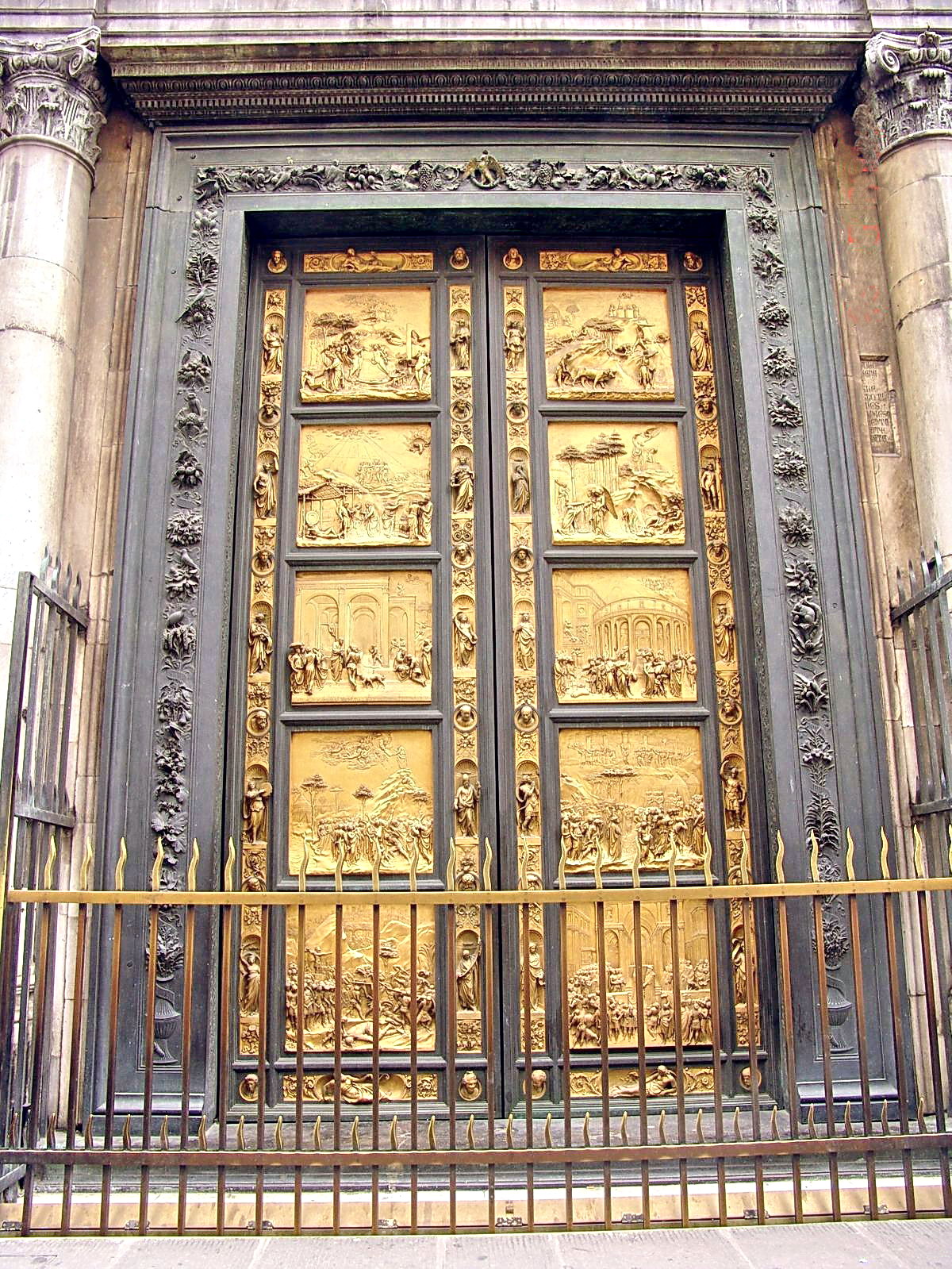
This race for employment shows only one facet of how deeply ingrained competition was in the Florentine psyche. The master sculptor Lorenzo Ghiberti was chosen from among many contest entrants to build the "Gates of Paradise" for the Battistero of San Giovanni. Brunelleschi's spectacular dome -the greatest architectural feat in a millenium- that sits atop Florence Cathedral was likewise a prize-winning design. In fact, the masterpieces of Florence's Leonardo da Vinci, Michelangelo and Sandro Botticelli all emerged from the dust of this struggle to win contracts from noble families and the Papacy. This was an era before reckless self-expression hampered the creative genius of artists, and art's inspiration was found in the tastes and culture of its audience. "Primavera," "Mona Lisa," the ceiling of the Sistine Chapel, and countless other masterpieces, all stand as testimonies, not only of timeless beauty and vision, but of how "infinite in faculty" the human genius can be when allowed to enjoy the fruits of its labor.

Thursday, March 24, 2011

The Power to Destroy

Most people who didn't sleep through their high school history classes are familiar with the Supreme Court case McCulloch vs. Maryland. Those who were the brighter stars in their constellations may even remember the essence of the dispute: In the midst of an ongoing firestorm over the relationship of the state and federal governments, the Second Bank of the United States mischievously established a branch in Maryland. The state legislature fired back by passing a bill that placed such a tax burden on the bank that it couldn't hope to make a profit. Chief Justice John Marshall rejected this bill and with it the ability of a state to impede a Federal project. He declared that "the power to tax involves the power to destroy." As you can see, it was an interesting era; one where "Federal government" and "larceny" weren't yet synonyms.

This blush of youthful innocence wouldn't last terribly long, however, thanks to a Federal government that overcame the troublesome check of the states by learning to wage unjust wars by unjust means. In 1861 the first (and, at that time, unconstitutional) income tax was passed as part of the Revenue Act of 1861, confiscating 3% of the annual income of Americans to aid the war effort. Prior to this, the Federal government's revenues had come mainly through indirect taxes like excise fees, and for good reason. Indirect taxes targeted events rather than specific people or property. The Founding Fathers' revolt against governmental power run amok had been partly because of the ease with which direct taxation could be abused. They enshrined this experience in the Constitution's Article Nine, expressly forbidding an income tax. Any remembrance of this was all but drowned out by the furor of the Civil War years. In 1862, a second act was passed that expanded on the Revenue Act. A bedrock precedent was laid for the progressivism of the early 1900s when the 16th Amendment was passed, making the income tax constitutional. At first rates were well below 10%, but with newfound legal authority came newfound abuse, and they began to climb steeply. At first, there were seemingly good reasons, like World War II. But it is the nature of injustice once justified to numb its victims. The 1940s' jump in rates by more than 400% was quickly followed by less extenuating, and more suspicious, reasons to which there was little resistance. With a seemingly unlimited pool of wealth to draw from, America was soon the proud owner of several bizarre accomplishments characteristic of a government with more money than it needs: Korea, Vietnam, and the Great Society.

Edward Gibbon's Decline and Fall of the Roman Empire contains a very striking account of what eventually happens when a nation allows its government to prey directly upon the fruits of its labor: "In the sixth year of his reign Constantine visited the city of Autun, and generously remitted the arrears of tribute, reducing...the proportion of their assessment...to eighteen thousand heads, subject to the real and personal capitation [i.e., income tax]. Yet even this indulgence affords the most unquestionable proof of the public misery. This tax was so extremely oppressive...that, whilst the revenue was increased by extortion, it was diminished by despair: a considerable part of the territory of Autun was left uncultivated; and great numbers of [citizens] rather chose to live as exiles and outlaws than to support the weight of civil society."