Showing posts with label Romanticism. Show all posts

Friday, November 11, 2011

In Praise of Myth

Before God was declared dead in 1882, the European elite had lost their willingness to believe. Nietzsche’s famous statement simply reflected the grave error of thinking that the intelligentsia’s lack of faith had nullified God’s faithfulness. Years before, European academia as a whole, stretched and stressed between rationalism and pantheism for decades, had made the fatal decision to play it safe and discard faith for reason. These Deists, blind to anything but what they could stare at past their own noses, promptly found that the next logical thing to do was to throw out the object of their faith, too.

Yet despite the relentless march of over a century-and-a-half of “progress,” the rocks still haven’t had to cry out (it must be frustrating to be a secular visionary). It seems that faith in something is as fundamentally needed in the human condition - even in its fallen-ness- as breathing. Think about it. It doesn't matter what archaeologists' spades do or don't uncover deep in the English loam. King Arthur held court in Camelot, surrounded by a troop of gallant knights. In the same way, the story of Robin Hood emerging from the shadowy eves of Sherwood Forest to secure justice for the oppressed is every bit as real in our mind's eyes as if he had existed just as the tales say he did. 

Decades of stressing objectivity, empiricism and rationalism in our schools have failed to erase these pictures, these “forms” that lie somewhere in the back of our minds in a place reason can’t reach. In the process of trying to snuff them out and preach only what we can know with absolute certainty, we've reduced history to a jumble of numbers and equations and proofs. Endless pages of quantitative statistics are needed to establish causality – and even then scientists accept that, at best, we can only know “probabilistic” truth. We've bumped up against the same wall through reason for which we through faith out the window.

And here we are, unable to teach Arthur or Robin Hood in history courses; unable to incorporate our highest aspirations and fears – in short, anything resembling a purposeful story – into scholarship. But why? Are these impressions false? Do they pervert our sense of history simply because they can’t be corroborated by a rock some farmer's plow caught upon by chance? Quite obviously, in the search for absolute meaning, it’s a zero-sum game: science has come up just as short as “myth.” I’m not saying legends should be taught as fact, but I am saying that they would not have been believed in the first place unless they contained a grain of truth. More importantly, in their essence they convey more truth than ten thousand pages of quantitative analysis. Arthur embodied for the Welsh the same kind of hope in a temporal redemption that they had in a spiritual one. Robin Hood will always be a lesson of compassion and justice conquering in the face of unjust rulers. In the words of Winston Churchill, "It is all true, or it ought to be." Which is safer? To accept things that we can't know beyond the shadow of a doubt and risk being wrong once in a while, or to acknowledge that we can't know anything?

Thursday, October 20, 2011

The Language of Creation

"Caspar David Friedrich in his Studio,"
Georg Friedrich Kersting, 1819
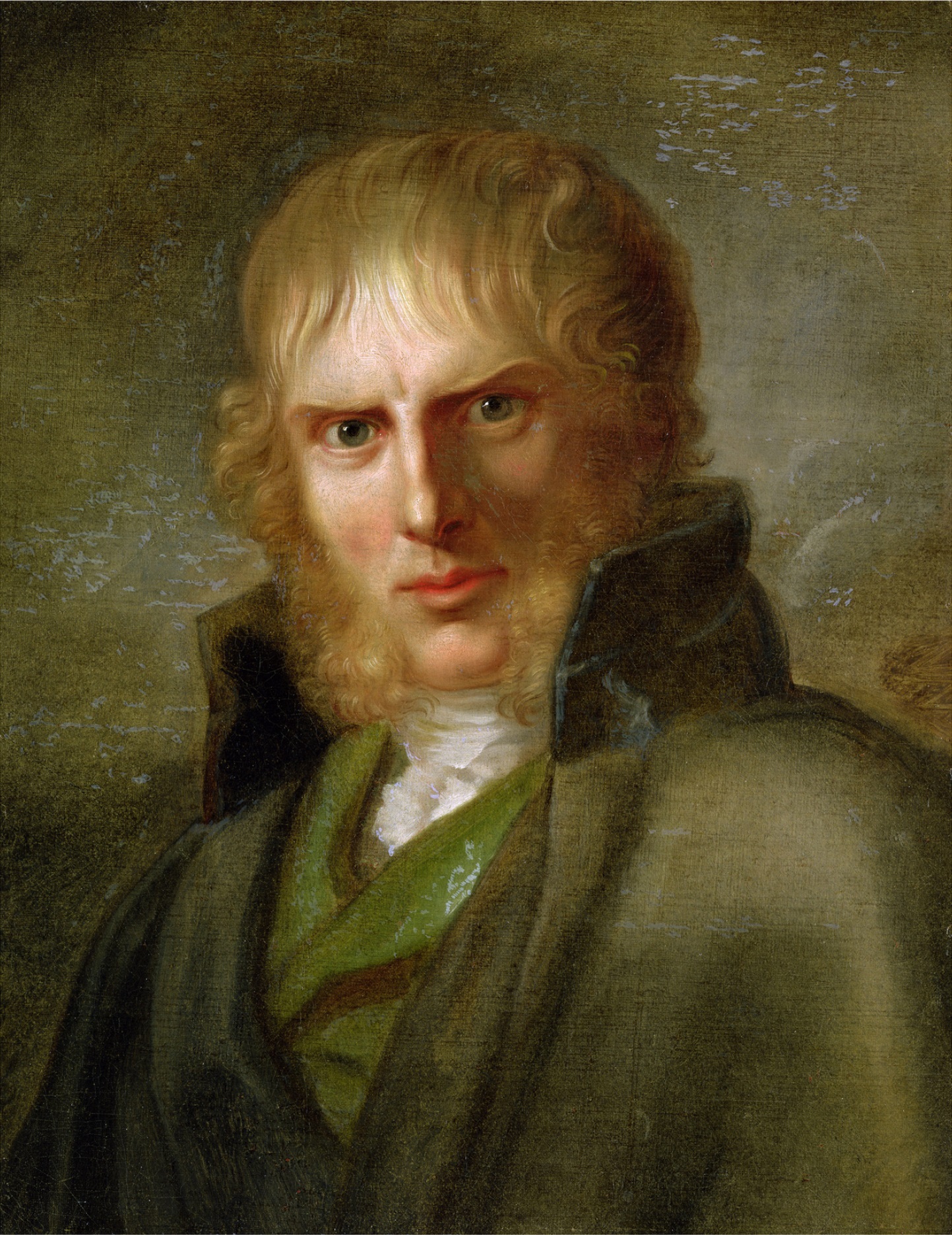
Christmas Day, 1807. The Count of Thun and his family fought blustery winds on their way to their private chapel at Tetschen castle, Bohemia. This year's religious pageantry was made all the more spectacular by a new addition to the sanctuary. There, in place of the old, ponderous altar-piece stood a newly-finished masterwork. A glinting frame enrounded a painting of Calvary reimagined in an Alpine setting, craggy and crowned by firs. The cross itself stood silhouetted by the brilliant pink hues of a setting sun. This was The Cross on the Mountains, the first major work in what was to be the long and brilliant career of German painter Caspar David Friedrich.

This painting was not just an expression of faith, it was a way for the Thun family to show a cosmopolitan streak. Friedrich’s work was part of a fashionable new movement that was attempting to wash the Enlightenment out of Western Europe. The previous century's overreaching search for rational truth had left the earth a barren wasteland through its insatiable desire to force all knowledge inside of men’s heads. Mysteries and miracles that didn’t conform to formulas had been rejected. For the first time in centuries, Christianity had been publicly attacked. The artists in this new school styled themselves “romantics.” By depicting the inexplicable, the beautiful, and most of all, nature in its glory, they sought to free men from bondage to their minds. Others, chief among them Caspar David Friedrich, painted to remind men that it was not just truth that could be found throughout all of creation, but the truth of the Christian God.

The Cross on the Mountains drew its most vehement criticism, not from Deistic intellectuals, but from a most unlikely source: a fellow Christian. That Christian was the aptly named Basilius von Ramdohr. Unlike Friedrich, von Ramdohr was born and bred among the upper classes of German society. He had acquired a reputation as a conservative lawyer and defender of traditional German values, which led to a career as a cultural critic. With a hint of contempt, no doubt, von Ramdohr went to see Friedrich’s much talked about "romantic" piece when it was on special display. He was deeply unsettled by the painting, so much so, in fact, that he wrote a painstakingly long refutation of the ideas he saw represented in it. He objected that the pine trees had been illustrated to the point of painting each needle. The way the light was rendered was against “all the rules of optics.” And what of landscape paintings themselves? Surely nature itself can contain no explicit meaning and is improper in a church. The rock was rendered poorly, a “most strident contrast to the bright sky, without any transition or harmony.” Perhaps worst of all, in von Ramdohr's opinion, the cross was not located in the center of the painting, and Jesus was not facing the viewer – and surely this would convey the wrong message to worshipers..

With his fledgling reputation at stake, Friedrich was forced to respond. His answer? “Jesus Christ, nailed to the tree, is turned here towards the sinking sun, the image of the eternal, life-giving father. With Jesus’ teachings, an old world dies – that time when God the Father moved directly on the earth. This sun sank and the earth was not able to grasp the departing light any longer. There shines forth in the gold of the evening light the purest, noble metal of the Savior’s figure on the cross, which thus reflects the earth in a softened glow. The cross stands erect on a rock, unshakeably firm like our faith in Jesus Christ. The firs stand around the cross, evergreen, enduring through all ages, like the hopes of man in Him, the crucified.”

Unfortunately, it is very easy for us Christians to make the same mistake von Ramdohr did. In our very desire to keep the Gospel pure, it is tempting to keep our artists in the shadows. We are prone to confusing convention with the Gospel; to thinking that a change in style means a change in substance. Can God only speak through us when we make sure that two pieces of wood are at the exact center of our painting like von Ramdohr wanted? The Bible tells us that God can speak through donkeys, rocks, burning bushes and David’s harp-playing. We forget that though symbols may change, Christ himself can still remain at the center of the work. The greatest stories of salvation are usually told, not through hackneyed altar-calls, but through metaphors. Jesus’ parables are prime examples of this. And what is nature but a majestic metaphor? By depicting Creation in a way that's good and beautiful (Philippians 4:8), we can challenge peoples' deepest beliefs. A God who's evident through the physical world challenges today's naturalists in a way they can't respond to. On the other hand, to deny nature’s revelation of God like von Ramdohr did is to deny what God called “good.” Like the Apostle Paul before his conversion, this man was an intellectual who thought he was advancing the kingdom of God by purging it of false revelation. It turned out that what they were both calling false was God's voice. What place do landscape paintings have in church? Friedrich showed in his response what the psalmist declared long before in chapter 19: "The heavens declare the glory of the Lord; the skies proclaim the work of his hands. Day after day they pour forth speech; night after night they reveal knowledge."

Monday, March 28, 2011

Romanticism and Christianity

When we think of movements in art or culture, its tempting to fixate on where they lead, not where they begin. Consider the Enlightenment. Instead of seeing it as a rejection of abject superstition and ignorance in favor of a view of an ordered world created by an ordered God, we see it as humanism or a megalomaniacal IQ exercise by old, dead, white men. But what are the facts? The Enlightenment began with the Protestant rediscovery of the Bible through which God could speak to people individually. It was confirmed in the discoveries of rational scientific laws by the Christian scientists Newton, Kepler and Copernicus. The same is true with Romanticism. The utopian communities and Transcendentalism we associate with the movement don't do it justice; actually, they distort the truth. To judge a thing by where it leads in its extremes is a fallacy by which we would have to condemn the idea of “civilization” since it always ends in ruins, or “life” since it ends in death.

By the late 18th century, the Enlightenment had digressed into absolute faith in man's ability to discern truth for himself, attacks on Christianity, and degradation of nature into a machine for man's exploitation. Romanticism began by simply voicing opposition to each of these points. According to distinguished historian Isaiah Berlin's The Roots of Romanticism, the earliest person to have done so in a “Romantic” way was the German philosopher Johann Georg Hamann. Hamann had received a broad education before his life began to fall apart in the pursuit of pleasure. Then, upon discovering the Bible, he was transformed and aligned himself with the Lutheran Pietists. A tireless writer, Hamann earned his nickname “Magus of the North” by churning out treatises in response to the dangerous theories of his Enlightenment friends who placed human Reason on a pedestal. He wrote to one of his closest friends, Immanuel Kant, “Reason is not given to you in order that you might become wise, but that you may know your folly and ignorance; as the Mosaic law was not given to the Jews to make them righteous, but to make their sins more sinful to them.” To reinforce this point, Hamann insisted that faith in God alone could lead one to a knowledge of the truth through his Holy Spirit. He deliberately styled himself after Socrates, the man whose greatest strength was his insistence that he knew nothing.

Unlike the other philosophers in his circle, Hamann never held a post at a university, but he did attract an enthusiastic following. One of his students was another Lutheran: a scholar and a priest, named Johann Gottfried Herder. Together, Herder and Hamann's ideas inspired a new genre of German art called Sturm und Drang. In its eschewing of rationality as the basis of truth, this style of music, plays and books profoundly influenced Goethe and all later Romanticists, including the master painter Caspar David Friedrich and his profoundly Christian artwork. Meanwhile, the Christian elements of this message had reached France, where the nobleman Francois Rene de Chateaubriand was hard at work writing what would become one of the brightest ornaments of the Romantic movement: The Genius of Christianity. This book argued that "Christianity comes from God, because it is excellent,” and defended it from its Enlightenment critics by arguing that the very beauty of the Christian religion was a proof that it was true. Chateaubriand's thesis was a tremendous influence on Lord Byron and other Romantics, but they unfortunately dropped the author's orthodoxy in favor of his aesthetic finesse. This was increasingly true of the Romantic movement as the 1800s wore on. Like the Enlightenment before it, the movement that had started as a Christian reaction to error branched out farther and farther from its original purpose and looked for truth somewhere other than in God. For the Romantics, this door to understanding became the senses instead of the mind, as it had been for the Rationalists. But let's not forget how it began. Rather than lamenting where movements in the arts, philosophy and culture may go in the end, Christians should be inspired that they have, and can still, frame the discussion from the beginning.