Monday, September 26, 2011

The Forgotten Father of Constitutional Liberty

Stephen Langton, from the exterior of
Canterbury Cathedral
Very little is known about Stephen Langton's childhood. What we do know is that he was born in the late twelfth century in the county of Lincolnshire. He first emerges from the shadow of obscurity as a star pupil at the University of Paris, where he befriended a fellow student who later became Innocent III, the most powerful of medieval popes. Thanks to this friendship, Langton was made a cardinal years later. He became renowned throughout Europe as a prolific expositor of scripture, publishing commentaries and treatises  - he even divided the Bible into the chapter/verse format we're so familiar with today. As profound as these accomplishments were, they pale in comparison with his greatest.

Hundreds of miles away, Langton's home was being torn between the teeth of Normans and Saxons, rich and poor, barons and king, church and state. The latest controversy was who would be Archbishop of Canterbury and therefore control the English church. King John had his man who would be sure to be loyal to the Crown, and the churchmen of England had theirs. Innocent III, ever intent on strengthening Papal power wherever it reached, saw an opportunity here to bring the English church firmly under Rome's control. He stepped in and engineered the election of a third candidate: a friend and a champion of the church; someone who would take orders from Rome without question. Langton's election was thus engineered, and King John's vengeance predictably broke out like a torrent.The struggle mounted until the king's plundering of the church resulted in his excommunication.

As serious as this conflict was, in English minds it was only a sideshow to one that had been simmering for centuries - that of barons and king. Every monarch since William the Conqueror had seen his greed for land, power and money frustrated by his equally greedy nobility. These barons were tired of spending their lives and fortunes in fruitless contests for what they considered the foreign lands in France.This friction between throne and fief had embroiled the kingdom in almost constant civil war for generations. Now that King John had been declared apostate by the church, this civil war became a holy war for the barons.

There seemed to be a thousand different ambitions clashing in the realm, like a pack of dogs tearing each other to pieces without a goal in mind. Langton saw an opportunity to bring order from the chaos, and it was now that he leaped into the contest. He had been reminded of something which the lords and churchmen of England could use to the advantage of themselves and the kingdom and posterity. He called for a council of churchmen and barons at Westminster, where he reminded those assembled of a certain "Charter of Liberties" which John's great-grandfather, Henry I, had been compelled by the barons to sign. True enough, that charter had dealt with only inconsequential matters like the illegality of certain fees kings had been accustomed to collect. But Langton saw here a precedent: that kings, too, were under the law. The Charter of Liberties should be expanded, renewed, and used to keep a lawless king accountable. With loud shouts of acclamation, the council swore an oath to conquer or die in defense of their liberties.

By now, however, the wily king had outmaneuvered his enemies. By swallowing his pride and submitting to the pope he had secured a powerful ally, but it had not been without a price. John's olive branch was nothing less than England itself - it would be governed as a Papal fief. Innocent III had jumped at the opportunity, but Langton balked. The last thing he wanted was more exploitation of the English people, whether from Westminster or Rome. Yet, the tables were now turned against him, and his cause was still fruitless. Continuing the struggle to check the king would mean going against the full might of both church and state. Perhaps Innocent had been misinformed. Clinging to that hope, the archbishop urged the barons to continue their efforts to check the king's ambition by refusing to submit to his taxes, and pressuring him to renew the Charter of Liberties or face open rebellion. John remained unmoved, and so in June 1215 the barons gathered their might to march on London, whose gates were thrown open by a sympathetic populace. There, with support from both France and Scotland, they forced John to agree to approve a royal charter that recognized the rights of his noblemen and, for the first time, codified legal limits to the king's power. Langton hurriedly set to work articulating the barons' grievances.

Dutifully, and no doubt seethingly, the king and his entourage processed to the nearby meadow of Runnymede to sign this charter in the midday sun of June 15, 1215. What he was forced to affix his seal to cannot have pleased him.The charter that Langton and the barons produced went far beyond the provisions of the Charter of Liberties in its effort to restrain the Crown. A few examples will suffice: Section 12 of this "Great Charter" said that "No scutage or aid shall be imposed on the kingdom unless by common counsel...." This principle became a rallying cry that found its way into subsequent charters until it was enshrined in the English Bill of Rights and became a principle of our own Revolution: "no taxation without representation." Section 20 said that barons could only be judged by their peers, not by courts in the pocket of the king. Freemen, too, would be judged by the oaths of honest men in their own neighborhoods. If this principle of English liberty sounds familiar it's because the Sixth Amendment of our Constitution contains it: "In all criminal prosecutions, the accused shall enjoy the right to a speedy and public trial, by an impartial jury of the State and district wherein the crime shall have been committed." The guarantee of a "speedy trial" was also found originally in Magna Charta: "To no one will we sell, to no one will we refuse or delay, right or justice." The document further guaranteed the rights of merchants, provided that all sheriffs and constables would be "competent" and first enumerated the idea of a constitutional government: "All fines made... against the law of the land...shall be entirely remitted." To enforce these concessions, a council of 25 barons was appointed to oversee the king, his laws and fines.

Shortly after signing Magna Charta, John proceeded to break nearly every rule in it with the full sanction of Innocent III (who also condemned the document). John's successors, too, were not particularly more faithful to its idealistic clauses. But this does not mean that Langton's work was forgotten. It gave the struggle against tyranny a profound legitimacy, and the idea of a limited monarch entered into political thought. To see just how much the document mattered to the nation, consider that over the next two hundred years, the English kings were forced to renew the document over 30 times. Finally, during the dictatorial reign of Charles I (1600-1649), what were by now considered centuries' old liberties were transferred into the English Bill of Rights, thus diffusing throughout the English-speaking world to, among other places, America, where the principles Langton had devoted his life to securing found their way into colonial charters, state constitutions, and the United States Constitution itself.


Thursday, September 8, 2011

Rousseau, Human Nature and Our Foreign Policy Problem

Put aside for a moment the constitutional arguments (and they are many) against being involved in the internal squabblings of governments overseas. Put aside the pragmatic arguments of finance and sustainability that see these wars for the vacuous black hole that they are. Even put aside the Founding Fathers' warnings against "foreign entanglements." Let's examine the philosophical moorings required to think we can"make the world safe for democracy."

As Christians, it is our duty to not only recognize, but actively live like we believe that sin is something each of us has the choice -the free-will- to indulge in or resist. Furthermore, God tells us in his word that man is fallen, that he delights in sin, just as St. Augustine delighted in stealing an apple, not to eat, but for the pure pleasure of sinning.  How does this reverberate into how we should see man's place in civil society? He is a law-breaker by choice. 

Not everyone agrees with what the Bible says, however. In fact, for a couple hundred years now it's been in vogue to take a position that owes more to Jean Jacques Rousseau: that man is born free and decent, and it's society's institutions that corrupt him. Break the back of these institutions and a violent man suddenly finds himself cherubized. Freud agreed. Man is a complex animal without a soul who responds to impulses in his environment. Pavlov believed that his famous discovery of reinforcement and the salivating dog was equally true of human beings: man is mechanical and needs stimuli to provoke the "right" responses. As these theories became mainstream, education shifted from its classical focus on searching for truth and instead began treating children like Pavlov's dog. It became about conditioning children to make the right responses to stimuli in the world.

Once this generation of children became adults, they could be found at the helm of this nation and most others in the Western world. They had a firm belief in the innate goodness of man - if only the harmful stimuli can be removed. Man is perfectible if he can just be given the right environment. Crime was no longer the rebellion of the soul, it was the automatic response to poverty and inner-city decay. Housing projects and the welfare state resulted. But there was something else, too. If this picture of human nature was true, then it was now within the grasp of the government of the United States of America not only to perfect its own citizens, but to perfect the citizens of the world - in effect to create a new world order of peace and prosperity for all. To free them to that natural state that Rousseau had talked about. Remove the evil effects of institutions and governments and you will cure the men under them. Or in more modern terms: "If we only remove the dictators, they will be good people." The French tried it in their Revolution of 1789. We did it in Cuba, in Europe (twice) and all across the third world ever since, and we've seen how it's played out. Iran was one of our first projects in the 1950s. Now it's Iraq and Afghanistan, which, despite all dreams of flag-waving Iraqi children, are not Jeffersonian democracies or anything remotely like. Egypt has been delivered, not to democracy, but to the Muslim Brotherhood. Now there are reports that Libya may be falling under the sway of Al Qaeda.

The problem of our foreign policy is primarily a problem with our view of human nature. Try as we might to export freedom and American ideals, our plans will continue to backfire until we understand that we cannot make men and women desire freedom by getting rid of the evil around them. Correcting our foreign policy starts with understanding that sin is a choice; that any inherent desire for freedom and democracy in the human race is outweighed by an inherent desire to sin. People around the world need to be reached by the Great Commission, not by Operation Odyssey Dawn.

Sunday, July 24, 2011

Thomas Jefferson and Leading By Example

A perilously high national debt, burdensome taxes, corruption, political favors, extreme partisanship, a powerful executive branch, and a bitterly divided government. Does any of this sound familiar? It may surprise you, then, that I’m describing the United States as it was in the afterglow of John Adams’ administration over two hundred years ago. It’s true that, in relative terms, taxes, debt and the size of the national government in 1800 were a vastly different affair from what they are today. But it was a more principled world, where infractions that we may think small were taken greater notice of and recognized as a threatening precedent for posterity.

Carried by the tumultuous winds of politics, it was the Virginia gentleman, philosopher and statesman Thomas Jefferson who was chosen to lead the young nation. He was to be a sort of shepherd to lead them away from the shadowy valleys of nationalism to the still waters of republicanism. Although dubious as usual about being away from Monticello, Jefferson ascended triumphantly -but without Adam's pomp and circumstance- into the swamp that was Washington D.C. (it was still under construction). After ten years of European-style experiments with national banks, standing armies, censorship of newspapers, excise taxes and piling on of debt, Americans were ready to see the Revolutionary goal of “a wise and frugal government” manifested. They got just that in the “Revolution of 1800.”

We are familiar today with incoming presidents talking up bipartisanship and then proceeding to stack their deck with friends, relatives and donors. Typically, they blame the other side of the aisle for every problem the country experiences. Jefferson set a different course. After declaring "We are all Republicans, we are all Federalists" in his First Inaugural Address, he answered Adams' last minute stuffing of the government with Federalists with stunning decency. By refusing to replace any except the most dogmatic among them with Republicans, the president diffused the cyclical feuding that had seized the nation for years. The next problem to fix was one of finance, and Jefferson began by selling  the stately coach, swords and elements of ceremony that Adams and Washington had favored. The president of the nation's first republic could often be seen braving the muddy streets of Washington on foot. The example he intended to set among his countrymen extended to his dress, which was very plain, a practice most shocking to foreign dignitaries. He made himself readily available to any and all. In fact, it was his rule to respond to every letter, and receive every guest who called on him during his presidency.

The federal government in 1800 was minuscule by today's standards, employing around 130 men. However, a number of these had been hired by the treasury under Hamilton's spendthrift secretaryship. Jefferson thought the positions an unnecessary waste of the peoples' money, so he eliminated them. In like manner, he scrapped more than half the navy (believing it encouraged foreign adventurism), reducing the government's expenditures by more than 25% even while abolishing the excise taxes that the previous administrations had devised. To Jefferson, a government with debt unnecessarily led its people down the road to servitude. A couple years of thriftiness later, his administration became the first to entirely pay off the national debt. Although some of Jefferson's later years would tarnish the brilliant beginning of his presidency, he left an example of how a president who leads by example, and is the first to take the sacrifices he asks others to accept, can heal a torn nation and give it a strength and solvency that has yet to be matched again.

Friday, June 3, 2011

From Burke's "On the Sublime and Beautiful:" the Effects of Tragedy

"IT is thus in real calamities. In imitated distresses the only difference is the pleasure resulting from the effects of imitation; for it is never so perfect, but we can perceive it is imitation, and on that principle are somewhat pleased with it. And indeed in some cases we derive as much or more pleasure from that source than from the thing itself. But then I imagine we shall be much mistaken, if we attribute any considerable part of our satisfaction in tragedy to the consideration that tragedy is a deceit, and its representations no realities. The nearer it approaches the reality, and the farther it removes us from all idea of fiction, the more perfect is its power. But be its power of what kind it will, it never approaches to what it represents. Choose a day on which to represent the most sublime and affecting tragedy we have; appoint the most favourite actors; spare no cost upon the scenes and decorations, unite the greatest efforts of poetry, painting, and music; and when you have collected your audience, just at the moment when their minds are erect with expectation, let it be reported that a state criminal of high rank is on the point of being executed in the adjoining square; in a moment the emptiness of the theatre would demonstrate the comparative weakness of the imitative arts, and proclaim the triumph of the real sympathy. I believe that this notion of our having a simple pain in the reality, yet a delight in the representation, arises from hence, that we do not sufficiently distinguish what we would by no means choose to do, from what we should be eager enough to see if it was once done. The delight in seeing things, which, so far from doing, our heartiest wishes would be to see redressed. This noble capital, the pride of England and of Europe, I believe no man is so strangely wicked as to desire to see destroyed by a conflagration or an earthquake, though he should be removed himself to the greatest distance from the danger. But suppose such a fatal accident to have happened, what numbers from all parts would crowd to behold the ruins, and amongst many who would have been content never to have seen London in its glory! Nor is it, either in real or fictitious distresses, our immunity from them which produces our delight; in my own mind I can discover nothing like it. I apprehend that this mistake is owing to a sort of sophism, by which we are frequently imposed upon; it arises from our not distinguishing between what is indeed a necessary condition to our doing or suffering anything in general, and what is the cause of some particular act. If a man kills me with a sword, it is a necessary condition to this that we should have been both of us alive before the fact; and yet it would be absurd to say, that our being both living creatures was the cause of his crime and of my death. So it is certain, that it is absolutely necessary my life should be out of any imminent hazard, before I can take a delight in the sufferings of others, real or imaginary, or indeed in anything else from any cause whatsoever. But then it is a sophism to argue from thence, that this immunity is the cause of my delight either on these or on any occasions. No one can distinguish such a cause of satisfaction in his own mind, I believe; nay, when we do not suffer any very acute pain, nor are exposed to any imminent danger of our lives, we can feel for others, whilst we suffer ourselves; and often then most when we are softened by affliction; we see with pity even distresses which we would accept in the place of our own."

Tuesday, May 31, 2011

Florence: the Architecture of a Renaissance

To live in Florence in the mid-fifteenth century was to be at the center of the world and the crossroads –or as it seemed to its inhabitants, the fount- of civilization. The narrow, medieval streets had given way to stately lanes wide enough to accommodate bustling cavalcades of merchants and tradesmen. All along the streets stretched shops upon shops. Rising above these were palazzos flanked by high gates, geometric gardens and statuary. This was the reign of Lorenzo de Medici, or “Lorenzo the Magnificent” as he quietly encouraged himself to be known. The Medici were a medieval success story. Over several generations, they had pulled themselves from obscurity to become the bankers to many noble families in Italy. They had even earned the distinction of protecting the Papacy's enormous assets. Since the turn of the fifteenth century, a combination of trade, usury and philanthropy under the Medicis' direction had transformed Florence into the "Athens of the Middle Ages" and the home and patron of Europe's master artisans.

The city was anything but peaceful, and its wealth made it a tempting prize to other city states. The busy streets were not seldom the site of riots, workers' strikes, and lynchings by families jealous of the Medici's power. In the midst of this tumult, Florentines learned that it is neither peace nor security that guarantees prosperity. Like Athens millenia before, the city-state of Florence was the birthplace of a renaissance (in this case, the Renaissance) because of the competitive spirit of its people and rulers. The ingredients were all there. As early as the 13th century, the guilds had secured fair competition through the "Ordinances of Justice." Florence was also the home to Europe's soundest currency since antiquity: the "florin." This foundation of lawful commerce paved the way for an explosion of enterprise. Much to the consternation of the common people of the city, immigrants (the "gente nuovo") poured in, pushing costs of labor down and production sky high.

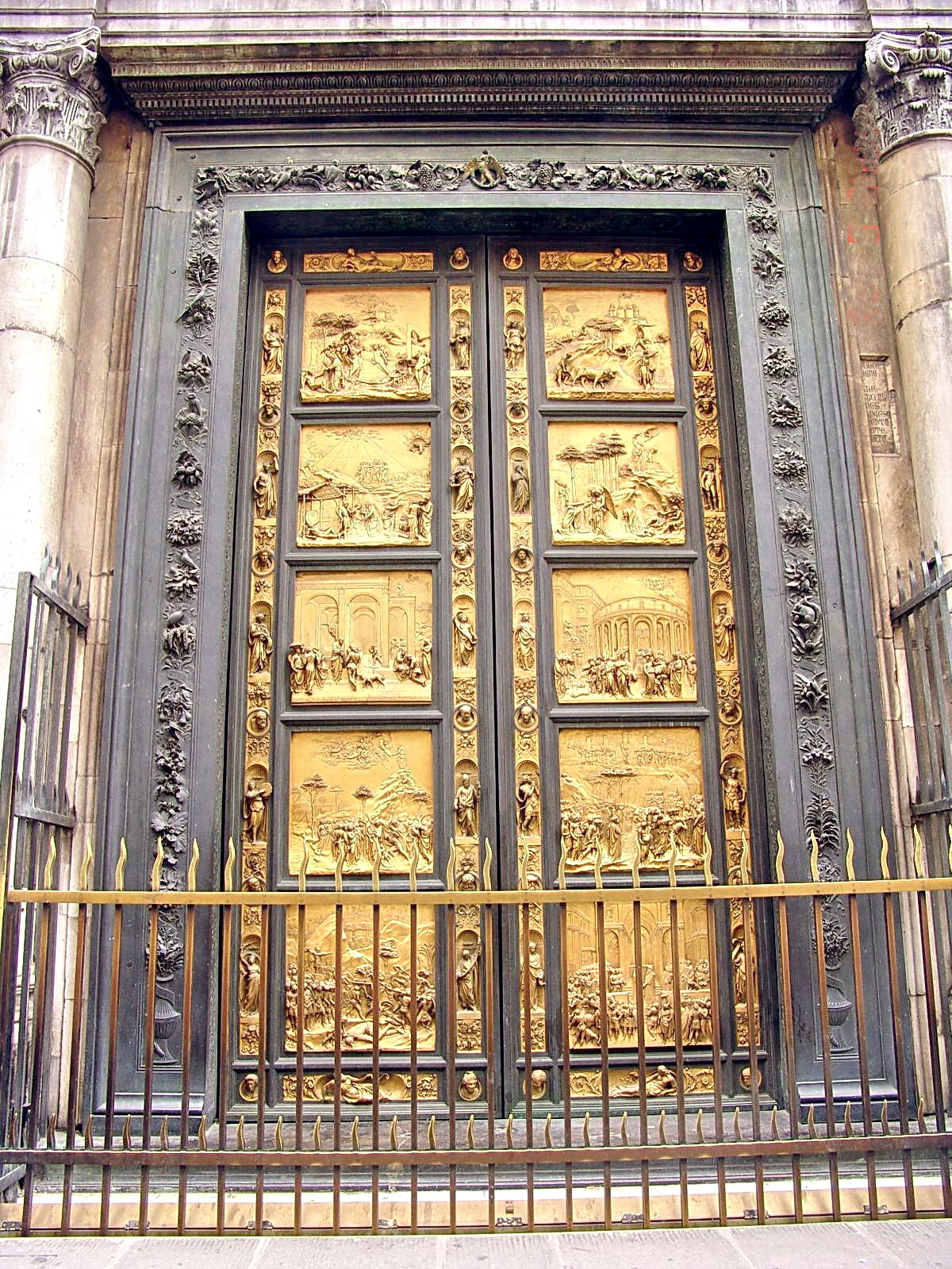
This race for employment shows only one facet of how deeply ingrained competition was in the Florentine psyche. The master sculptor Lorenzo Ghiberti was chosen from among many contest entrants to build the "Gates of Paradise" for the Battistero of San Giovanni. Brunelleschi's spectacular dome -the greatest architectural feat in a millenium- that sits atop Florence Cathedral was likewise a prize-winning design. In fact, the masterpieces of Florence's Leonardo da Vinci, Michelangelo and Sandro Botticelli all emerged from the dust of this struggle to win contracts from noble families and the Papacy. This was an era before reckless self-expression hampered the creative genius of artists, and art's inspiration was found in the tastes and culture of its audience. "Primavera," "Mona Lisa," the ceiling of the Sistine Chapel, and countless other masterpieces, all stand as testimonies, not only of timeless beauty and vision, but of how "infinite in faculty" the human genius can be when allowed to enjoy the fruits of its labor.